
Preventive maintenance
Preventive maintenance software that runs on schedule
Set recurring maintenance schedules — daily, weekly, monthly, quarterly, yearly, or every N days — and Snippath automatically generates the work orders when they're due, with the right checklist and assignee already attached. Stop relying on memory and spreadsheets to keep equipment serviced.
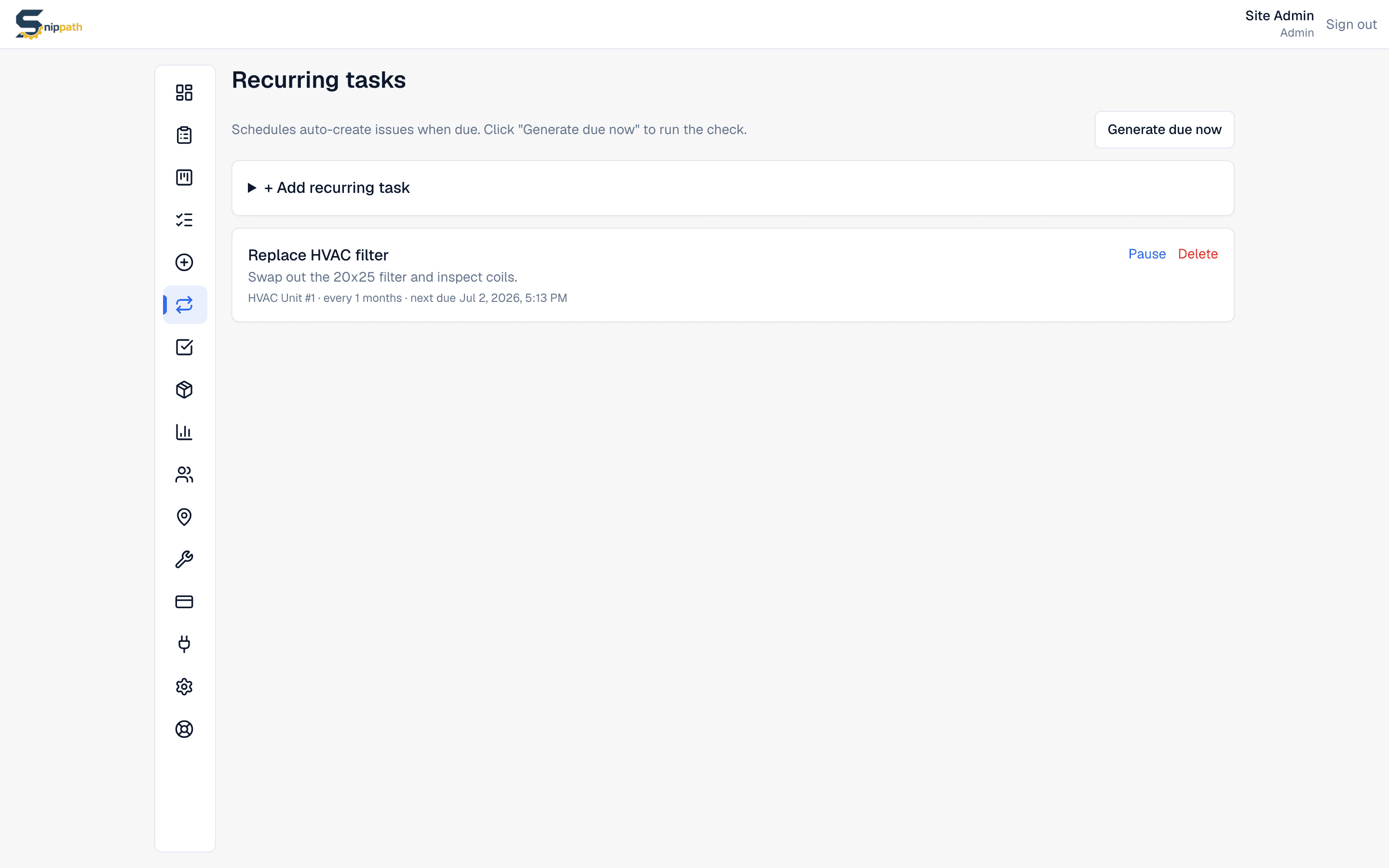
How a schedule works in Snippath
A recurring task holds everything a future work order needs: a title template like "HVAC Unit 3 — monthly filter change", a description, the linked asset and location, a priority, an optional default assignee, and an optional default checklist. You pick a frequency — daily, weekly, monthly, quarterly, yearly, or every N days, weeks, or months — and a start date. A background job runs every hour; when a schedule comes due, it creates a real work order and, if there's a default assignee, pushes a notification to their phone.
Checklists make PMs verifiable
The strongest pattern is attaching a checklist to the schedule, so every generated work order arrives with the inspection steps built in. Items marked Required must be checked before the ticket can be closed — Snippath blocks the Done status and lists what's missing. Items can also require a photo, which is how you get gauge readings and before/after proof without nagging anyone. "Marked complete" becomes "here are the twelve checked items and four photos."
History accrues on the asset
Because each schedule links to a piece of equipment, every generated work order — with its minutes logged, parts used, and completed checklist — lands in that asset's history. Over a year you get a real service record: when the filters were actually changed, what the compressor has cost in parts and labor, and which machine keeps generating unplanned repairs despite the PM program.
Schedules don't silently slip
If last month's PM ticket is still open when the next one comes due, Snippath creates the new one anyway — outstanding work never quietly pauses the schedule, and the pileup itself tells you something is wrong. You can pause a schedule explicitly (seasonal equipment, a machine out for rebuild) and resume it later. Edits to a schedule apply to future tickets only; already-generated work orders keep their original settings.
A month in the life
A gym sets up three schedules: weekly treadmill belt inspections with a photo-required checklist, a monthly pool-pump service assigned to the one tech who knows it, and quarterly fire-extinguisher checks. Nobody remembers anything; the tickets simply appear, assigned and checklisted, and the manager's board shows at a glance which PMs are done and which are sitting in Open. When the fire marshal visits, the completed checklists are the paper trail.
The honest limits
Snippath's preventive maintenance is calendar-based only. There's no meter-based PM yet — you can't trigger a service every 500 runtime hours or 5,000 miles — which matters for fleets and heavy machinery; it's on our roadmap but not shipped, and tools like UpKeep or Fiix do it today. Asset hierarchy is one level deep — a parent machine with sub-equipment whose costs and hours roll up — not an arbitrarily nested tree. We'd rather tell you this here than have you find out after signing up.
What it costs
Recurring schedules and checklists unlock on the Pro plan: $49 per month flat for the whole workspace, unlimited users. Compare that to per-seat CMMS pricing at $20–45 per user per month, where a 10-person team pays $2,400–5,400 a year before it schedules its first PM. On Snippath the price is the same whether two people or twenty run your PM program, and you can start on the free plan and upgrade only when you're ready to automate.
Frequently asked questions
- What is preventive maintenance software?
- Software that schedules recurring maintenance and automatically creates work orders when tasks come due, so routine servicing happens on time instead of being forgotten. In Snippath, each schedule carries a title, asset, priority, default assignee, and default checklist, and an hourly background job generates the tickets — complete and ready to work.
- Can I set custom maintenance intervals?
- Yes. Frequencies include daily, weekly, monthly, quarterly, yearly, or every N days, weeks, or months, each with its own start date. One honest limitation: intervals are calendar-based only. Snippath doesn't yet support meter-based PM (every 500 runtime hours, every 5,000 miles) — that's on the roadmap but not shipped.
- Which Snippath plan includes preventive maintenance?
- Recurring schedules and inspection checklists are on the Pro plan at $49 per month — flat for the whole workspace with unlimited users, not per person. The free and Starter plans cover work orders, assets, QR reporting, and (on Starter) parts inventory, so many teams start there and upgrade when they're ready to automate recurring work.
- What happens if the previous PM ticket is still open when the next one is due?
- Snippath creates the new work order anyway. Outstanding work never silently delays the schedule — if tickets start stacking up, the backlog itself is the signal that the PM program is understaffed or over-scheduled. If you genuinely need to stop generation, you pause the schedule explicitly and resume it whenever you're ready.
- Can a checklist be attached to every generated work order?
- Yes, and it's the main use case. Set a default checklist on the schedule and every generated ticket arrives with it pre-attached. Required items block the ticket from being closed until they're checked, and items can demand a photo — so completed PMs come with verifiable proof, not just a status change.
- Does Snippath support meter-based preventive maintenance?
- Not yet — this is a real gap. Snippath schedules are calendar-based (time intervals), with no runtime-hours or mileage triggers and no meter reading capture. Meter-based PM is on our roadmap, but if your operation depends on it today, a heavier CMMS like UpKeep or Fiix is currently the better fit. We list this on our comparison pages too.
Related
More features
See it for your industry
Snippath is a flat-rate CMMS — work orders, preventive maintenance, parts, and QR-code reporting, one fee per workspace. Free for 2 users.