
Inspection checklists
Inspection checklist software for maintenance
Create reusable checklists for inspections and standard procedures, then attach them to work orders so technicians tick off each step — with required items that block the ticket from closing and photo requirements for proof. Make sure nothing gets skipped, and keep a record that it was done.
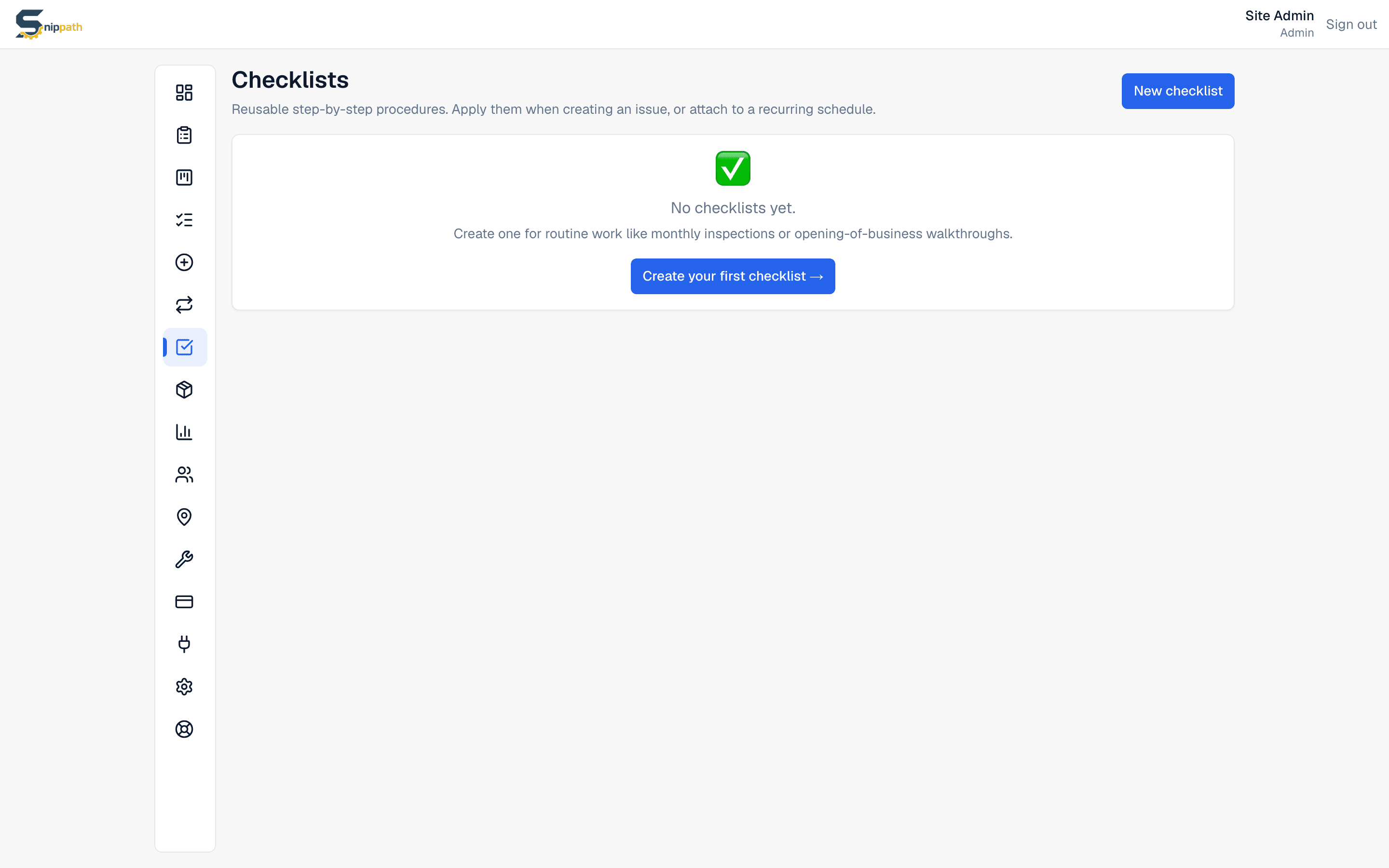
Build the procedure once
A checklist is a named template — "Monthly HVAC inspection", "Generator load test" — with a list of items. Each item can be flagged Required, meaning the work order can't be closed until it's checked, or Photo required, meaning the tech is prompted for a photo when checking it off. That's the whole model, deliberately: simple enough that your team actually uses it, structured enough to prove work happened. Five to ten items is the sweet spot; longer lists get skimmed.
Attach it manually or automatically
For one-off jobs, open any work order and attach a checklist from the picker. The main use case, though, is pairing checklists with recurring maintenance schedules: set a default checklist on the schedule and every auto-generated PM ticket arrives with the inspection steps pre-attached. The filter-change ticket that appears on the first of the month already contains the eight steps and the required photo of the new filter.
Required means required
As a technician works the ticket, the checklist sits right below the description — tap to check items off, with required ones marked by a red dot. When they try to move the ticket to Done, Snippath verifies every required item is checked; if not, it blocks the close and lists exactly what's missing. That single enforcement rule is what turns a checklist from a suggestion into a control — the safety step can't be skipped by marking the job complete.
Completed checklists are frozen in time
When you edit a checklist template, the changes apply only to work orders that get it attached afterward. Tickets already carrying the checklist keep the exact version they were created with — so a completed January inspection still shows January's steps even after you revise the procedure in March. Retired procedures can be archived: hidden from the picker for new tickets, preserved on every historical one. Your audit trail can't be rewritten by later edits.
A quarter in the life
A facilities team runs quarterly fire-extinguisher inspections as a recurring schedule with an attached checklist: gauge in the green (photo required), pin and seal intact, signage visible, access unobstructed. Each quarter the tickets generate themselves; techs walk the building checking items off on their phones. When the inspector asks for records, the manager pulls up the closed tickets — every item checked, every gauge photographed, dated and attributed. No binder, no reconstructing what probably happened.
Honest scope and limits
Snippath checklists are check-off lists with required and photo flags — there's no conditional branching, weighted scoring, or standalone audit forms, and a checklist always lives on a work order rather than running on its own. There's also no offline mode yet, so a tech in a signal-dead mechanical room needs to reconnect to sync. If you need scored multi-page audits, dedicated inspection apps do that better; if you need maintenance steps verified and recorded, this is the simpler tool that gets used.
Part of the Pro plan, flat
Checklists unlock on the Pro plan together with recurring schedules — $49 per month for the entire workspace, unlimited users. That pairing is intentional, since scheduled PMs with attached checklists is where the feature earns its keep. Per-seat competitors typically include checklists only in $40–75 per-user tiers, so a 10-tech crew can pay several hundred dollars a month for the same enforcement. On Snippath the tenth tech checking off items costs the same as the first: nothing extra.
Frequently asked questions
- What are inspection checklists in a CMMS?
- Reusable templates of steps attached to work orders, so technicians complete and verify each item as they work. In Snippath, items can be marked Required — the ticket can't be closed until they're checked — or Photo required for visual proof. They're used for safety inspections, compliance checks, and standardizing multi-step procedures across the team.
- Can I reuse the same checklist on many work orders?
- Yes. Build the template once and attach it to any number of tickets — manually for one-off jobs, or automatically by setting it as the default checklist on a recurring maintenance schedule, so every generated PM ticket arrives with the steps pre-attached. Each ticket keeps its own completed copy as a permanent record.
- What happens if a technician skips a required item?
- The work order won't close. When a tech tries to mark a ticket Done, Snippath checks every required checklist item; if any are unchecked, it blocks the status change and lists exactly which items are missing. That enforcement is the difference between a checklist as a suggestion and a checklist as a control.
- Can I require photo proof on checklist items?
- Yes. Flag any item as Photo required and the technician is prompted to attach a photo when checking it off — gauge readings, before-and-after shots, the new filter actually installed. The photos are stored with the completed checklist on the work order, which is what makes the record persuasive to an auditor or inspector.
- Do completed checklists create an audit trail?
- Yes, and it's tamper-resistant in a specific way: editing a checklist template only affects future tickets, while tickets that already have the checklist keep the exact version they were created with. A closed inspection permanently shows which items were checked, by whom, when, and with what photos — even if the procedure is revised later.
- Which plan includes inspection checklists?
- Checklists are part of the Pro plan at $49 per month, alongside recurring maintenance schedules — flat for the whole workspace with unlimited users. Per-seat CMMS vendors usually put checklists in $40–75 per-user tiers, so the flat rate matters most for exactly the teams that use checklists hardest: bigger crews with compliance requirements.
Related
More features
See it for your industry
Snippath is a flat-rate CMMS — work orders, preventive maintenance, parts, and QR-code reporting, one fee per workspace. Free for 2 users.