
Limble alternative
Paying $28 a seat for Limble?
Limble and Snippath are both modern, mobile-first maintenance management tools. Limble has been around longer and leans industrial. Snippath is newer, has flat per-workspace pricing, and a permanent free tier instead of a 30-day trial. Here's the honest breakdown.
In short: Limble is a well-regarded industrial CMMS priced around $28/user/month, with meter-based preventive maintenance and deep asset management. Limble no longer publishes prices on its pricing page — that figure comes from Limble's own cost guide, and it's a genuine cut from the ~$40/user many older roundups still cite, which narrows the gap for small teams. Snippath is a flat-rate Limble alternative — free for 2 users, then $19–$99/month per workspace — covering the core CMMS workflow for a fraction of the cost at team scale. Snippath fits small and mid-size teams on calendar-based maintenance; Limble is the better fit if you need runtime/meter-based PM or heavy industrial reporting.
Pick Limble if
- ·You run industrial / heavy-equipment ops
- ·You need IoT meter integration today
- ·You're already on Limble and it's working
Pick Snippath if
- ·Per-user pricing math doesn't work for your team
- ·You want a permanent free tier (not a 30-day trial)
- ·You want to be up and running in 5 minutes
See it
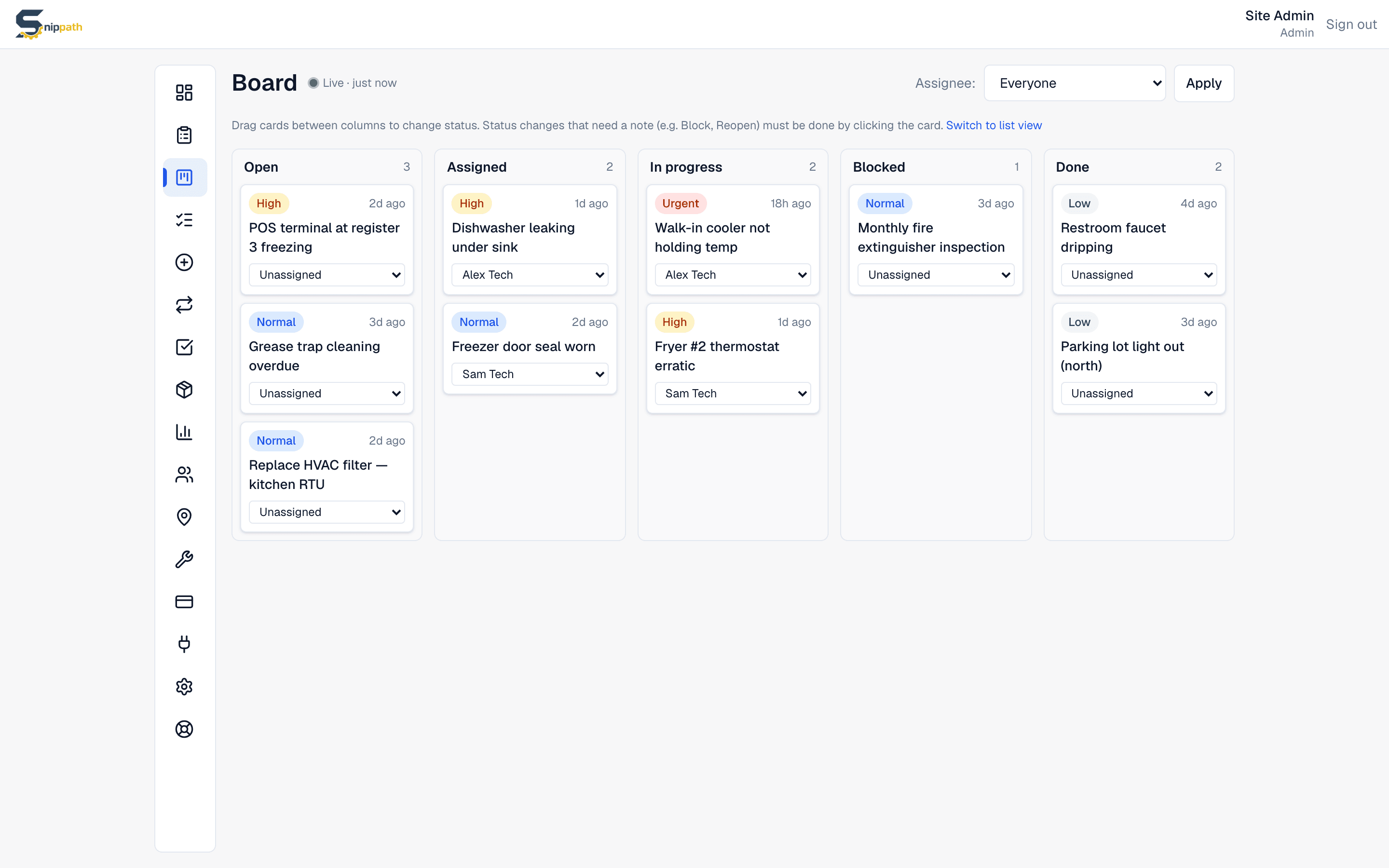
This is Snippath.
Switching from Limble? This is the board you'd move to — work orders open to done, assigned and prioritized, on web or mobile. Flat-rate, free for 2 users.
Limble pricing at a glance
A 10-person team, side by side
Snippath is free for up to 2 users. Limble Standard pricing as published; some plans require annual billing.
Pricing
Per-user pricing still compounds — even after Limble's price cut.
Limble's entry-level Standard plan is $28/user/month— down from the ~$40 it charged until 2026, a real cut (likely competitive pressure) that makes Limble cheaper per seat than before and narrows the gap for small teams. To be transparent about sourcing: Limble no longer publishes prices on its pricing page (only a "calculate my price" tool), so these figures come from Limble's own cost guide. Snippath is one flat fee per workspace — $19/mo on Starter, $49/mo on Pro, regardless of team size — so the gap still widens with every user you add.
5-person team
12-month total10-person team
12-month total25-person team
12-month total50-person team
12-month totalComparing Limble Standard ($28/user/mo) against Snippath Starter (≤10 users) and Pro (10+ users). Limble Premium+ ($69/user/mo) and Enterprise (custom) widen the gap further. Limble no longer publishes prices on its pricing page — figures come from Limble's own cost guide at limble.com/learn/cost (updated 2026-03). Prices verified 2026-08.
Features
Feature-by-feature.
Limble has a deeper feature set, especially around meter-based PM, vendor management, and integrations. Snippath covers the same core CMMS workflow with a tighter scope and faster setup. Here's the full grid.
Core CMMS
| Feature | Snippath | Limble |
|---|---|---|
| Work order tracking | ||
| Preventive maintenance scheduling | ||
| Asset / equipment registry | ||
| Parts inventory + reorder thresholds | Spare parts on Premium+ ($69/user) only | |
| Inspection checklists | ||
| Per-asset cost / labor history |
Reporting & access
| Feature | Snippath | Limble |
|---|---|---|
| Public QR-code report form | Standard on every plan | Anonymous portal on higher tiers |
| Mobile PWA (no app store) | Native iOS/Android apps instead | |
| Native iOS / Android apps | PWA covers same use cases | Offline mode on Premium+ only |
| Push notifications | ||
| Web-based reporting + CSV export | ||
| Time tracking | Work timer + manual entry (Pro) |
Pricing model
| Feature | Snippath | Limble |
|---|---|---|
| Per-user pricing | Flat per-workspace | |
| Flat workspace pricing | ||
| Permanent free tier | 2 users, 25 active issues, unlimited time | 30-day free trial only |
| No annual contract required | Monthly available but ~25% more expensive |
Enterprise & integration
| Feature | Snippath | Limble |
|---|---|---|
| Public REST API | On Business tier (shipping) | Premium+ only |
| Webhooks | On Business tier (shipping) | |
| SSO (Google/Microsoft) | On Business tier (shipping) | |
| Custom domain (white-label) | On Business tier (shipping) | Premium tier |
| Audit log | On Business tier (shipping) | |
| Meter readings + meter-based PM | On roadmap | Premium+ only |
| IoT sensor integration | ||
| Vendor / purchase order management |
Team size + industry
Where each tool fits best.
Limble leans industrial — manufacturing, heavy equipment, fleets. Their IoT meters and vendor PO features matter most for those teams. Snippath is broader (facilities, hospitality, sports, light industrial) and tighter on team size.
Overlap zone (5-50 users) is where either could work. If you're running heavy industrial equipment with IoT meters, Limble. Everyone else, the pricing math points to Snippath.
Where Limble wins.
Honest pass — Limble has been refining their product since 2015. They have features we don't, and for some teams those features are the whole reason to pick them.
- ▸Meter readings + meter-based PM.Log values over time (HVAC hours, vehicle mileage, generator runtime). Schedule maintenance based on runtime instead of calendar dates. Essential for fleets and heavy machinery. On Snippath's roadmap but not shipped yet.
- ▸IoT sensor integration.Ingest data from condition-monitoring sensors (vibration, temperature, runtime). Important for industrial equipment justifying sensor deployment. Snippath doesn't do this.
- ▸Vendor + purchase order management. Track external vendors, generate POs, manage receiving. Snippath has parts inventory but no vendor module.
- ▸Mature integration marketplace.Native connectors for SAP, Procore, Salesforce, plus Zapier. Snippath's API (Business tier, shipping soon) requires more glue work.
- ▸Established mid-market customer base.Limble lists Rite Aid, Hilton, McDonald's — recognizable industrial / facilities customers. Real social proof for enterprise procurement.
- ▸Native mobile apps.Dedicated iOS + Android apps in the app stores. Snippath is a PWA — installs to home screen, sends push, but isn't in App Store / Play Store.
Where Snippath wins.
- ▸Pricing still isn't close. A 5-person team saves ~$1,450/year. A 10-person team saves ~$3,100/year. A 50-person team saves ~$16,200/year. Limble's 2026 price cut from ~$40 to $28/user narrowed these gaps — credit where due — but its per-user model still punishes growth; Snippath's flat fee rewards it.
- ▸Permanent free tier vs 30-day trial. Limble gives you 30 days to evaluate, then forces a decision. Snippath gives you 2 users + 25 active issues forever, no time limit. Real use beats evaluation under pressure.
- ▸QR-code public reporting is standard.Print stickers, scan with any phone camera (no app), file a pre-filled report in 30 seconds. On every Snippath plan including Free. Limble's anonymous portal is on higher tiers.
- ▸Time-to-setup.Snippath takes ~5 minutes from signup to first ticket. Limble's onboarding involves a sales call, demo, and typically a multi-day implementation.
- ▸Speed. Modern stack (Next.js, Postgres, edge assets). Pages load instantly, especially on mobile. Limble has been around longer and shows it in places.
- ▸Mid-cycle plan changes prorate automatically. Upgrade or downgrade anytime; Stripe handles the math. No re-negotiating annual contracts.
- ▸Honest scope.This page itself is the proof — we'll tell you exactly what we don't do. No'contact sales' for standard features.
Which one should you actually pick?
Pick Snippath if you're under 50 users and don't need IoT meters.
The savings range from ~$1.5k to $16k+ per year. Most small-to-mid teams in facilities, hospitality, fitness, sports, light industrial fall here.
Pick Snippath if you want to actually use it before deciding.
Limble's 30-day trial forces a buy decision before you've finished onboarding your team. Snippath's permanent free tier (2 users, 25 issues, unlimited time) lets you evaluate on real work without the clock.
Pick Limble if you run industrial equipment that needs meter-based PM.
Snippath does calendar-based scheduling but doesn't yet read hour meters or runtime. If 'service every 500 hours' is core to your workflow, Limble ships that today.
Pick Limble if you need vendor management + POs.
Snippath tracks parts but doesn't manage external vendors or generate purchase orders. Limble does both. If procurement is part of your maintenance workflow, that's worth real money.
Try Snippath first — it's free.
The downside is 30 minutes of your time. Compare against your other shortlist by actually using both on real work. The one you reach for tomorrow is the right one.
FAQ
How much does Limble cost? (2026 pricing)
Limble's paid plans are per user per month — Standard is $28/user/month and Premium+ is $69/user/month, with Enterprise custom. Limble no longer publishes prices on its pricing page (it only offers a 'calculate my price' tool), so these figures come from Limble's own cost guide, updated March 2026. Note the $28 is a cut from the ~$40 many older roundups cite. A 25-person team on Standard pays roughly $8,400/year. Snippath is flat-rate instead: free for 2 users, then $19–$99/month per workspace no matter how many people you add.
What's the best Limble alternative?
For teams that want flat-rate pricing instead of $28/user/month, Snippath is the closest Limble alternative — same core work-order, preventive-maintenance, parts, and QR-code reporting workflow at one fixed fee. Limble itself is the better fit if you need meter/runtime-based preventive maintenance (every 500 hours, every 10,000 miles).
Can I migrate from Limble to Snippath?
Yes. Limble lets you export assets, locations, and parts as CSV from their admin panel. Snippath's CSV import at /admin/assets/import takes the same format (name, identifier, location, notes). For work orders, we recommend exporting to CSV for archival and starting fresh — open tickets rarely benefit from a midway migration.
Snippath doesn't have meter-based PM. Is that a deal-breaker for me?
It depends. If you're maintaining vehicles, generators, or other equipment where the right interval is runtime-based (every 500 hours, every 10,000 miles), yes — Limble is the better fit until we ship meters. If your scheduling is calendar-based (monthly HVAC checks, weekly inspections), Snippath covers it.
What's the catch on Snippath's free tier?
No catch, but real limits: 2 users, 25 active issues. We make money from teams that outgrow Free. If you're a 1-2 person operation tracking under 25 active tickets, you can stay free forever. If you grow, you'll naturally upgrade.
Is Snippath as reliable as Limble?
Limble has more operational history. Snippath runs on DigitalOcean with nightly DB backups, automated uptime monitoring, error tracking via Sentry, and a public status page. Uptime is currently near-100% but our track record is short. For SLA-backed reliability commitments, neither tool's standard plans include them — you'd want Limble Enterprise or wait for Snippath's Business tier to ship full SLA terms.
What if I outgrow Snippath?
Honest answer: if you grow past ~100 users with deep integration needs (SAP, custom workflows, IoT, regulated industries), Limble or a similar mid-market CMMS will fit better. Snippath exports your full database on request — your data is portable. We'd rather you leave on good terms than feel locked in.
Other CMMS comparisons
- Snippath vs UpKeep → · the most-searched CMMS comparison
- Snippath vs MaintainX → · the closest competitor on price + free tier
- Snippath vs Fiix → · enterprise-leaning alternative
- All comparisons →
Try Snippath free.
2 users, 25 active issues, no time limit, no credit card. Use Snippath as long as you want at zero cost. Upgrade only when you actually need to.